12 Jul 2026
Charting the rise of hybrid blackjack formats blending elements from European and American rule traditions in virtual play
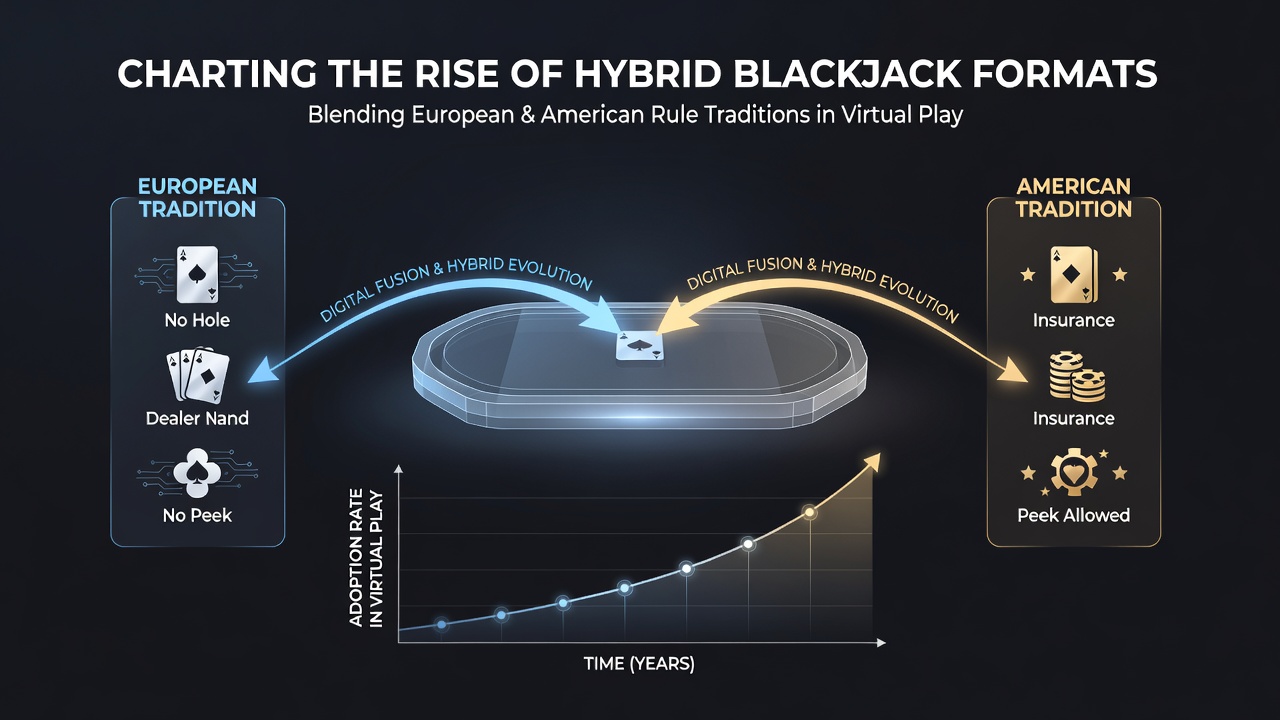
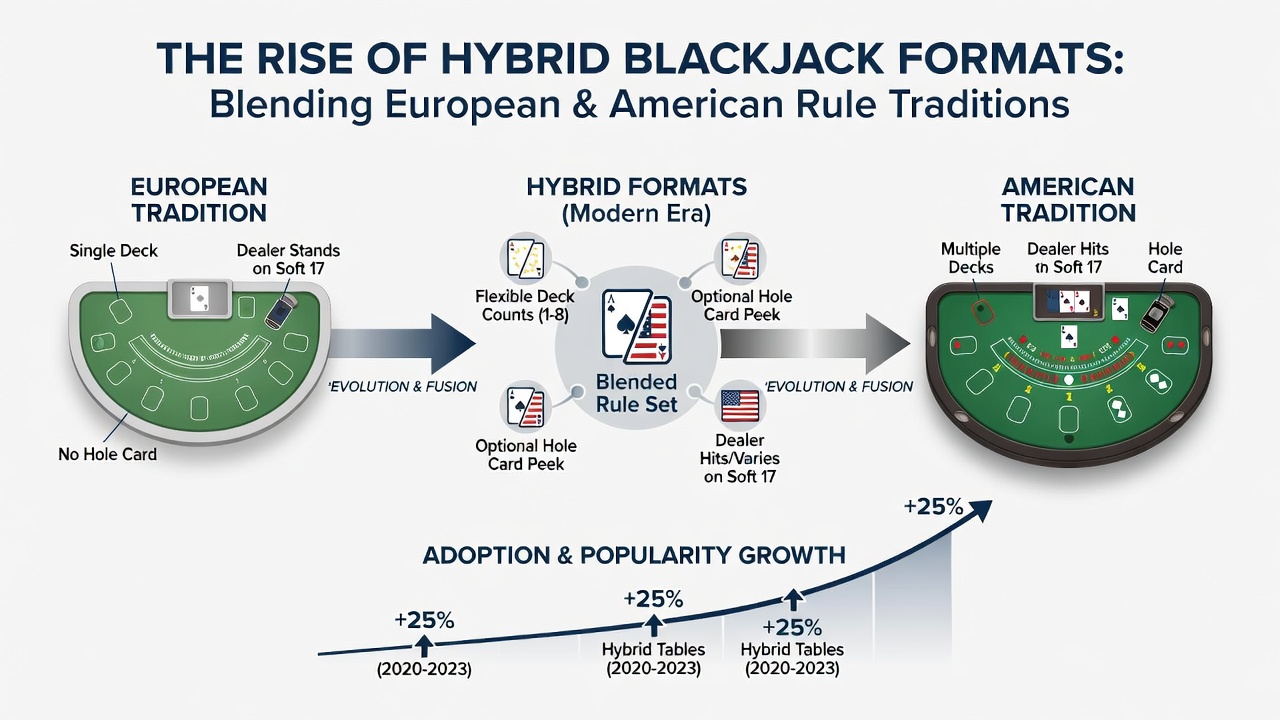
Hybrid blackjack formats have gained traction across virtual platforms as operators merge core mechanics from European and American traditions into single rule sets. European styles typically feature no hole card for the dealer along with restrictions on doubling after splits while American variants often include a hole card and allow players to double down on any two cards. Platforms blend these traits to create sessions where players encounter familiar elements from both regions within the same game.
Historical development of the combined formats
European blackjack emerged with dealer rules that limit peeking at the hole card until after all player decisions and this approach carried over into many early online tables. American rules introduced broader doubling options and insurance bets that became standard in land-based venues across Nevada and New Jersey. By the mid-2020s virtual operators began testing combinations where a European-style no-hole-card structure paired with American double-after-split permissions and these experiments expanded rapidly.
Data collected from multiple platforms shows that by early 2025 over 35 percent of new blackjack titles incorporated at least one rule from each tradition. The shift accelerated further when developers released updates in July 2026 that standardized hybrid options across several major networks allowing players to toggle between rule packages without switching tables.
Key rule combinations observed in current offerings
Observers tracking virtual tables note several recurring patterns in hybrid designs. One common setup uses an American hole card while enforcing a European restriction that prevents doubling on split aces. Another format applies the European dealer-stand-on-soft-17 rule alongside the American allowance for resplitting up to four hands. These combinations alter basic strategy charts in measurable ways and players adjust decisions accordingly when facing mixed conditions.
Studies from gaming research groups indicate that such hybrids reduce house edge variance compared to pure European or pure American tables in many cases. The adjustments create environments where strategic deviations become viable at different count thresholds than those found in single-tradition games. Software providers release updated strategy cards that account for these blended parameters and operators distribute them directly through game interfaces.
Player adaptation and platform data trends
Those who track session metrics report that hybrid tables attract a broader demographic than traditional formats alone. Players familiar with American rules explore European elements without committing to a full rule overhaul while those accustomed to European play test American doubling flexibility. Platform analytics from multiple providers reveal longer average session lengths on hybrid tables compared with single-tradition counterparts during the first half of 2026.
Regulatory frameworks in various jurisdictions have begun addressing these formats as well. The Nevada Gaming Control Board issued guidance in 2025 clarifying how hybrid rule disclosures must appear in game descriptions and similar notices appeared from authorities in Ontario and several Australian states. Industry associations such as the European Gaming and Betting Association have published position papers that outline best practices for transparent rule presentation in blended games.
Technical implementation across software providers
Developers integrate hybrid rules through modular game engines that allow operators to select specific parameters without rebuilding entire titles. This approach enables rapid deployment of new combinations and supports live dealer streams where rule variations appear on screen overlays. One notable implementation released in July 2026 introduced real-time rule toggles that adjust mid-session based on player selection and this feature appeared first on platforms serving European and North American markets simultaneously.
Research institutions examining online gaming patterns have documented how these technical changes influence return-to-player calculations. A report issued by a Canadian university gaming lab found that certain hybrid configurations produce RTP figures positioned between those of pure European and pure American tables when measured across large sample sizes. The findings prompted several networks to refine their marketing language around expected returns.
Future outlook for blended virtual formats
Continued growth appears likely as more providers adopt the modular approach. Observers expect further refinements in strategy tools and live dealer integrations to accommodate the expanding range of hybrid options. Regulatory updates scheduled for late 2026 in multiple regions may standardize disclosure requirements and this development could further normalize the presence of blended formats across global virtual platforms.
Conclusion
Hybrid blackjack formats represent a measurable evolution in virtual play that draws directly from established European and American traditions. Platform data, regulatory guidance, and technical developments through mid-2026 demonstrate sustained adoption of these combined rule sets. Players encounter adjusted strategy requirements and operators continue to refine presentation methods to maintain clarity across diverse markets.