22 May 2026
Screen Signals: How Visual Prompts Guide Decisions at Electronic Blackjack Stations
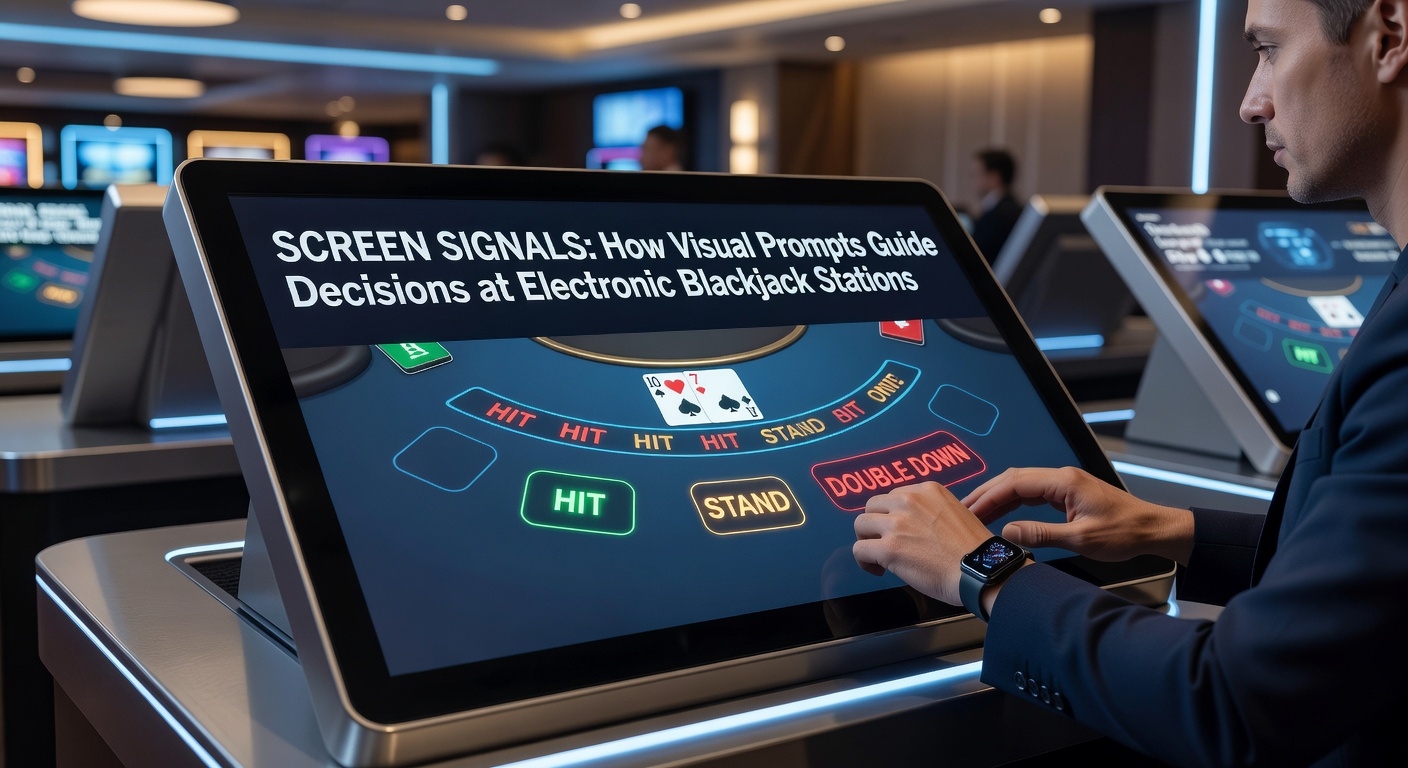
Electronic blackjack stations rely on layered screen elements that direct player attention through color shifts, animations, and timed indicators rather than spoken cues or physical gestures. These visual systems appear across casino floors in both land-based terminals and hybrid online setups, where players interact via touchscreens that update in real time. Data from gaming hardware manufacturers shows that stations installed since 2023 incorporate at least twelve distinct visual layers per hand cycle, ranging from bet confirmation flashes to payout meter expansions.
Core Visual Elements on Modern Terminals
Touch zones light up in sequence once cards are dealt, with green borders marking stand options and amber pulses highlighting hit buttons when the displayed total sits below seventeen. Observers note that insurance prompts activate a separate sidebar graphic that fills from left to right over a fixed four-second window, giving players a clear countdown without requiring external clocks. Researchers at the University of Nevada, Reno have documented how these sequential highlights reduce average decision time by roughly eighteen percent compared with earlier monochrome interfaces.
Card values receive dynamic overlays that adjust font weight and hue based on current hand strength, while the dealer’s upcard sits inside a fixed frame that pulses once per second during active play. Payout tables expand downward from the top margin whenever a side bet resolves, revealing exact credit increments alongside animated chip stacks that stack in ascending order. Such layered feedback loops keep information density high yet spatially organized, allowing experienced users to scan multiple data points within a single glance.
Integration With Game Flow and Timing
Betting rounds open with a central circle that contracts inward over thirty seconds, its circumference serving as both progress meter and minimum-stake reminder. When the circle reaches half radius, peripheral bet selectors dim by forty percent, directing focus toward the active wager area. Studies compiled by the Canadian Centre for Gaming Research indicate that terminals using graduated opacity shifts record fewer late-bet errors than those relying solely on numeric countdowns.
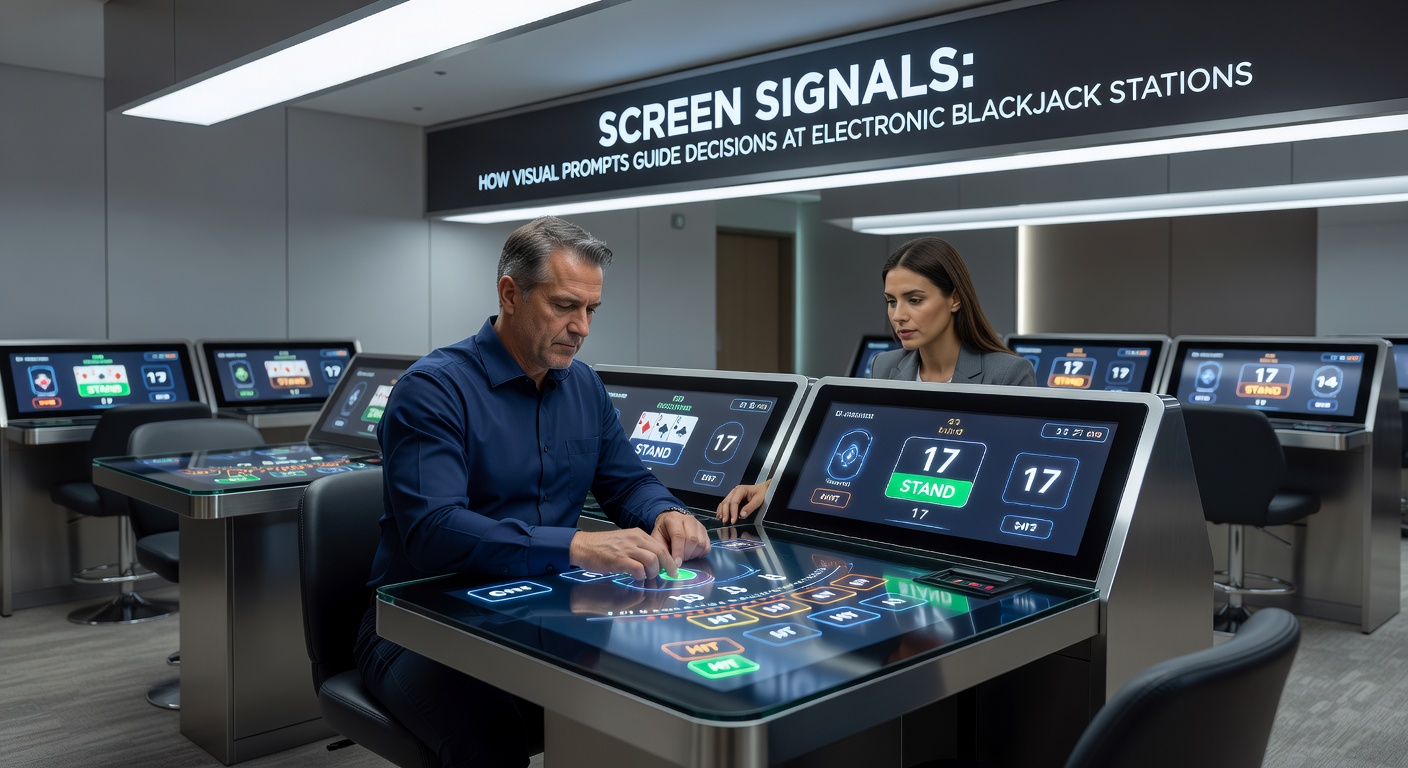
Electronic stations also embed shoe-composition indicators that appear as vertical bar graphs along the right margin. Each segment darkens as high or low cards exit the virtual deck, providing an abstracted view of remaining distribution without revealing exact card identities. Gaming regulators in New Jersey require these graphs to update within two hundred milliseconds of every card reveal, ensuring synchronization with the underlying random number generator.
Regional Standards and 2026 Developments
By May 2026 several European jurisdictions plan to mandate standardized color palettes for decision prompts, replacing operator-specific schemes with a unified system that uses cool blues for conservative actions and warm oranges for aggressive ones. Early adoption reports from test sites in Malta show that uniform palettes cut training time for new players by nearly a quarter. Meanwhile, Australian venues continue to refine haptic-linked visuals where screen vibrations accompany each color change, though these remain optional under current national codes.
Industry organizations such as the American Gaming Association track how visual prompt consistency correlates with session length across multi-station banks. Their 2025 dataset reveals that terminals featuring synchronized animations across adjacent units experience twenty-two percent higher repeat play rates than mismatched installations.
Player Interaction Patterns and Accessibility Features
Accessibility modules allow users to enlarge decision buttons or swap flashing cues for steady borders, adjustments that appear in menus triggered by a three-second hold on the screen corner. Data collected through terminal telemetry indicates that roughly nine percent of sessions activate at least one accessibility toggle, with enlargement tools proving most common among players over fifty-five. These customizations preserve core signal logic while altering scale and intensity, maintaining the same information hierarchy for all users.
Multi-hand modes split the display into separate panels that highlight active hands with brighter saturation while desaturating inactive ones. When a player switches focus, the newly selected panel expands by fifteen percent and its prompt sequence restarts, preventing overlap confusion. Observers tracking usage logs note that this spatial separation supports average play rates of four simultaneous hands without measurable increase in error frequency.
Conclusion
Screen-based signals in electronic blackjack stations have evolved into coordinated systems that combine color, motion, and spatial layout to convey timing, options, and outcomes within a compact interface. Continued refinement through 2026 centers on cross-jurisdictional standardization and accessibility layering, while preserving the real-time responsiveness that distinguishes these terminals from traditional table formats. As hardware and regulatory frameworks advance, the visual language of electronic blackjack continues to shape how decisions unfold at each station.