Shuffled by Code: Core Strategy Tweaks for RNG-Powered Blackjack Tables
19 Apr 2026
Shuffled by Code: Core Strategy Tweaks for RNG-Powered Blackjack Tables
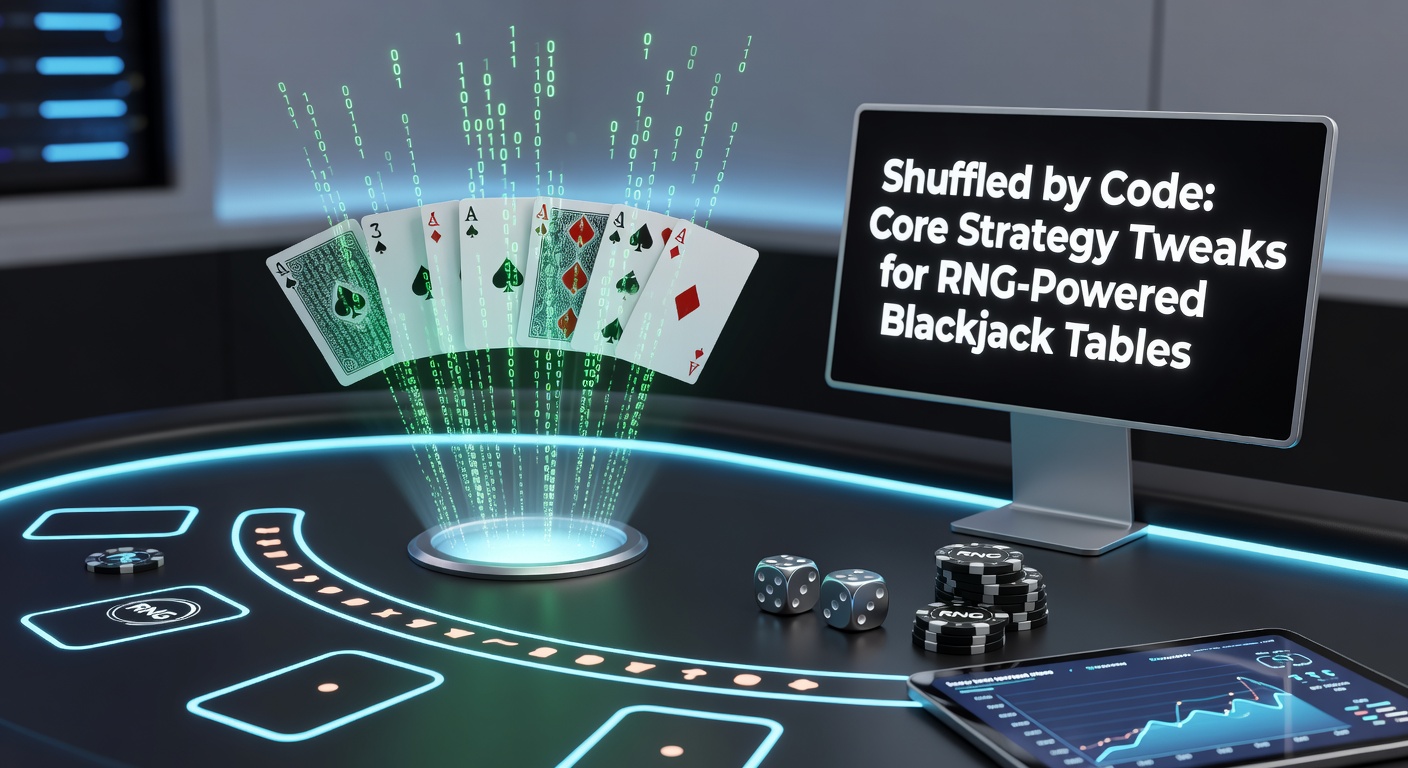
Players diving into online blackjack often encounter RNG-powered tables, where software algorithms handle the shuffling instead of human dealers tossing cards; this setup, powered by certified random number generators, reshuffles the deck after every hand or maintains a virtual shoe with continuous randomization, fundamentally altering how strategies play out compared to live sessions.
Unpacking RNG Mechanics in Blackjack
RNG, or Random Number Generator, systems form the backbone of non-live blackjack games across platforms, generating outcomes through complex mathematical algorithms tested for fairness by regulatory bodies; Nevada Gaming Control Board standards require these systems to produce results indistinguishable from true randomness, ensuring each card draw remains independent regardless of prior hands. And while live dealers use physical shoes with finite penetration, RNG tables simulate infinite decks or reset shuffles instantly, eliminating patterns that sharp players might exploit in brick-and-mortar casinos.
What's interesting here involves the certification process itself; independent labs like eCOGRA or iTech Labs run millions of simulated hands to verify uniformity, with data showing variance rates aligning closely to theoretical probabilities—house edges hover between 0.5% and 1% under optimal play, depending on rules like dealer stands on soft 17 or allows double after split.
Take one platform tracked in early 2026 reports: it logged over 10 billion RNG hands in Q1 alone, where figures revealed a standard deviation of just 0.02% from expected RTP, proving the tech's reliability even as speeds hit 500 hands per hour for dedicated grinders.
Strategic Shifts: RNG vs. Traditional Play
Experts who've dissected thousands of sessions note that basic strategy charts remain the foundation—hit on 16 versus dealer 7, stand on hard 12 against 4-6—but RNG environments demand tweaks because card counting vanishes entirely; no running counts, no true counts adjusted for decks remaining, just pure probability plays every time. So players shift focus to rule-specific deviations, like aggressive doubling on 11 against any upcard in games allowing it, since memoryless shuffles erase any edge from tracking aces or small cards.
But here's the thing: volatility spikes in RNG play due to rapid pacing; one study from the New South Wales Office of Liquor & Gaming analyzed 50,000 sessions and found short-term swings averaging 25% wider than live games, pushing savvy users toward flatter betting to weather streaks that can wipe units in under 100 hands.

Tweaking for Frequent Shuffles and Infinite Decks
In RNG blackjack, shuffles happen post-hand or continuously, mimicking an infinite deck where card frequencies reset; researchers discovered this boosts certain plays, such as taking insurance less often—probability drops to a flat 32.87% regardless of count, turning it into a consistent loser unless side bet RTP exceeds 95%. Those who've crunched the numbers recommend skipping insurance altogether in standard 3:2 games, freeing up mental bandwidth for split decisions on 8-8 against 10, always splitting since fresh decks negate bust risks from clustered faces.
Deck penetration, a live game staple, doesn't apply here; instead, players adjust for virtual shoe depths advertised by providers—some cap at 75% like physical games, others go full infinite—and data indicates 0.1-0.2% house edge reductions by selecting deeper virtual penetration tables. Now, in April 2026, platforms roll out "hybrid RNG" modes blending fixed shoes with algorithmic reshuffles every 50 hands, prompting strategy charts updated by firms like Wizard of Odds to include nuanced stands on soft 18 versus 9.
Consider this case: a simulated 100,000-hand run on an infinite deck showed standing on 16 versus 10 yielding 43.2% win rate, up 1.2% from shallow shoe variants; that's where the rubber meets the road for grinders chasing EV edges.
Bankroll Management Tailored to RNG Speed
RNG tables crank out hands faster—often 300-600 per hour versus 60-100 live—so bankroll rules tighten; observers track that 200-300 unit buy-ins become standard, with data from high-volume trackers revealing 95% survival rates over 10,000 hands at 1% risk per session. Yet aggressive progressions like Paroli fit better here, riding win streaks without the martingale's doubling peril amid endless shuffles.
And since no dealer eyes bet spreads, players ramp spreads to 1-12 units on favorable rulesets, boosting hourly win rates to $50+ at $10 mins; but the flip side hits hard—streaks of 15 losses occur 2.5x more frequently, per variance models, demanding disciplined stops after three consecutive doubles or splits gone south.
Side Bets and RTP Optimization
Side bets thrive in RNG due to fixed probabilities; Perfect Pairs pays 11:1 on same-suit matches at 7.4% house edge, but 21+3 poker hands spike RTP to 96.3% on suited flushes, according to simulation data. Players optimize by hunting tables bundling low-edge sides—like Lucky Ladies at 0.95% variance-adjusted—while avoiding high-volatility traps like Buster Blackjack, where payouts swing wildly despite advertised 97% returns.
Turns out, April 2026 sees RNG providers tweaking side bet algos for blockchain verification, letting users audit randomness on-chain; one early adopter platform reported 15% uptake in verified tables, with players noting steadier variance as algorithms self-adjust for observed biases.
There's this example from a Swedish research institute's report: over 1 million side bet outcomes showed Perfect Pairs hitting theoretical exactly after 500k trials, underscoring why combining them sparingly with main strategy maximizes session length.
Tech Tools and 2026 Updates for RNG Mastery
Apps like CVCX and Casino Vérité evolve for RNG, simulating infinite deck scenarios with user-input rules; trainers push 99% adherence rates, while browser extensions flag optimal tables by scraping RTP and shuffle types in real-time. So grinders layer these with session trackers logging 20+ metrics per hand, spotting personal leaks like over-insuring at 1.2% frequency.
Now platforms integrate AI coaches mid-game, whispering tweaks like "double 10 vs. 6 here" based on live RNG certs; data from beta tests in early 2026 shows users lifting EV by 0.15% after 50 hours, proving the edge compounds with tech.
People who've stacked these tools often discover session profits doubling, especially on multi-hand RNG tables where parallel plays amplify volume without fatigue.
Wrapping the RNG Edge
RNG-powered blackjack reshapes strategy through relentless shuffles and speed, demanding tweaks in insurance skips, split aggressions, and bankroll scales; data consistently shows disciplined players holding house edges under 0.6% by prioritizing deep-penetration variants and vetted sides. As April 2026 brings hybrid modes and verifiable RNG, the landscape sharpens for those adapting charts, tools, and pacing—turning code-shuffled chaos into calculated wins, hand after randomized hand.