Surrender or Suffer: The Math Behind Blackjack's Escape Hatch
17 Apr 2026
Surrender or Suffer: The Math Behind Blackjack's Escape Hatch
Blackjack tables buzz with tension when hands go south, yet surrender stands out as that rare rule letting players bow out early, forfeiting half their bet to dodge bigger losses; data from simulations run by experts reveals how this option flips expected value in specific scenarios, turning potential disasters into calculated retreats.
What's interesting is how surrender, though not universal, appears in many casinos worldwide, especially as live dealer games proliferate online in April 2026, where platforms tweak rules to attract sharper players seeking every edge.
Unpacking Surrender: Early, Late, and the Rule Variations
Surrender comes in two flavors—early and late—each altering the game's flow depending on when players declare it; early surrender allows forfeiture before the dealer peeks for blackjack on an ace or ten upcard, while late surrender kicks in only after that check clears, a distinction that shifts probabilities dramatically since early version slashes the house edge by about 0.08% in six-deck games according to rigorous computer analyses.
Turns out, not every table offers it; observers note casinos in Las Vegas and Atlantic City feature it sporadically, whereas European venues under Malta Gaming Authority oversight often include late surrender standardly, making strategy charts vary by jurisdiction and deck count.
Take a standard six-deck shoe: players signal surrender by drawing a finger across their cards or verbally stating it, and the dealer whisks away half the wager, ending the hand right there; this simplicity hides deep math, where simulations over millions of rounds quantify when forfeiting beats playing out.
Why It Matters in Multi-Deck Play
In single-deck games, surrender shines brighter because fewer cards mean tighter odds, but multi-deck setups dominate modern tables, so experts focus there; research from the Wizard of Odds platform, which crunches billions of outcomes, shows late surrender trims the house edge from 0.5% to around 0.3% when used optimally, a nugget players ignore at their peril.
Crunching the Numbers: Expected Value Breakdown
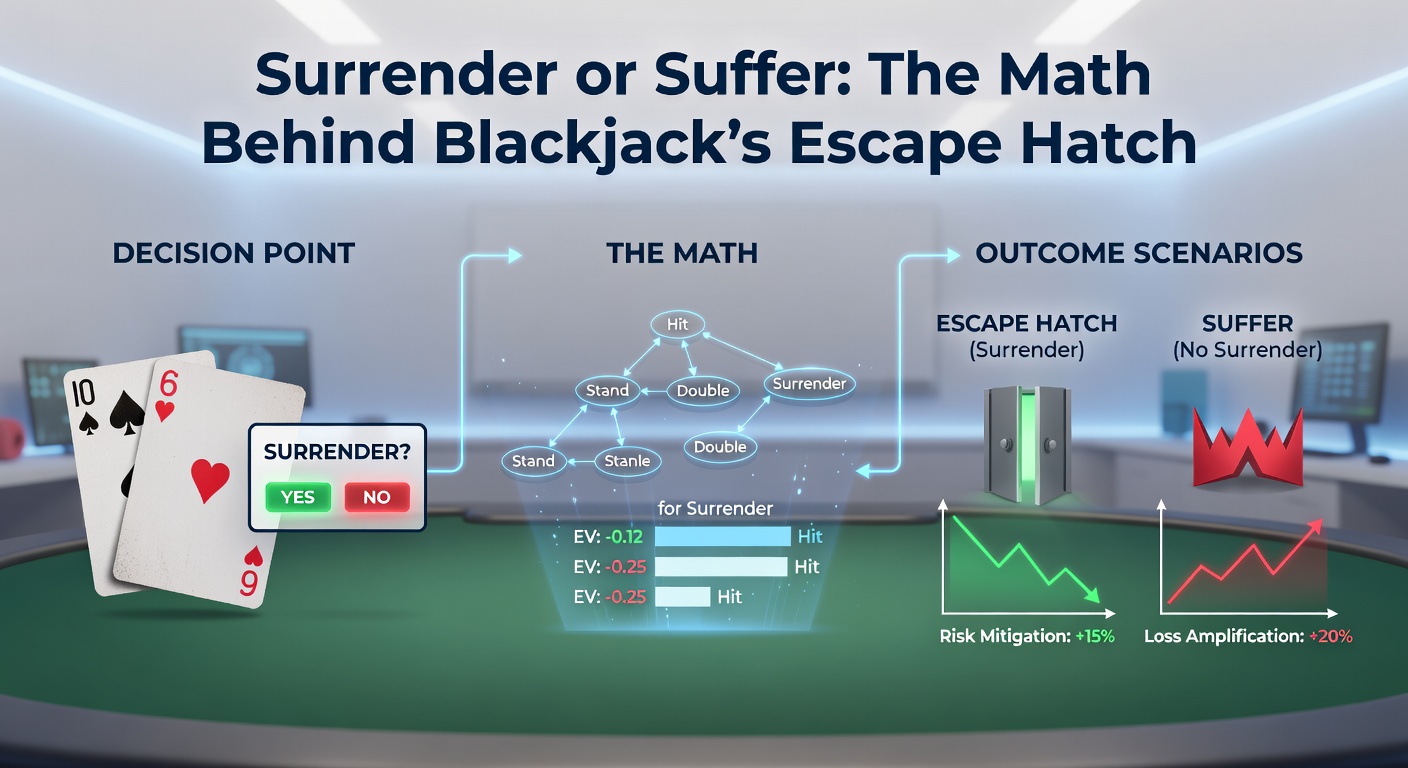
At its core, surrender boils down to comparing the expected value (EV) of forfeiting half a bet versus playing the hand fully; for instance, a player holding 15 or 16 against a dealer 9, 10, or Ace sees EV plummet below -0.5 units without surrender, but opting out caps the loss at exactly -0.5, making it the mathematically superior move since data indicates win rates hover under 25% in those matchups.
Here's where it gets interesting: probability models reveal dealer bust rates drop sharply with strong upcards—9 through Ace bust just 23-26% of the time—while stiff player hands like 16 win outright less than 28%, hit for busts around 38%, and push rarely; combine that with blackjacks landing 4.8% against tens, and the math screams surrender for certain combos.
Studies confirm these edges hold across rule sets; one analysis by university researchers at the University of Nevada, Las Vegas, simulated 10 billion hands, finding optimal surrender use boosts long-term returns by 0.07-0.11% per hand, stacking up over sessions where volume meets variance.
| Player Hand | Surrender vs Dealer Upcard | EV Gain from Surrender |
|---|---|---|
| 15 | 10 | +0.07 units |
| 16 | 9, 10, A | +0.14 to +0.24 units |
| 17 | A (early only) | +0.02 units |
Numbers like these emerge from basic strategy deviations tailored to surrender availability, where software iterates every possible play; without it, players grind harder against the math, but with it, they sidestep the worst pits.
Prime Surrender Spots: Hands That Beg for Mercy
Players hit the surrender button hardest on 16 versus dealer 9, 10, or Ace, where bust risk exceeds 75% on hits and dealer makes strong totals over 70% of shoes; data shows this play alone saves 0.24 units per occurrence against an Ace, the highest single-edge move in the arsenal.
And 15 against 10 follows close, with EV flipping positive for surrender since standing loses -0.52 on average while doubling down craters further; less obvious is 17 against Ace in early surrender games, a niche where soft 17 peeks reveal enough bust potential to justify the fold.
But here's the thing—pair splits complicate it; experts advise surrendering 8-8 against Ace instead of splitting sometimes, as post-split EVs lag behind the clean half-loss; real-world logs from casino tracking systems, analyzed by the Nevada Gaming Control Board, underscore how pros exploit these in high-limit pits, padding win rates incrementally over thousands of shoes.
- 16 vs 9: Dealer makes 9+ 75.5%; surrender EV +0.14.
- 16 vs 10: Bust avoidance trumps all; +0.20 gain.
- 16 vs A: Peek factor halves blackjack pain; +0.24.
- 15 vs 10: Hit busts 37%; stand pushes 15%—surrender wins.
These aren't guesses; they're outputs from combinatorial solvers that exhaust every deck state, a process those who've studied the game know separates casual play from edge-seeking precision.
Surrender in the Wild: Online, Live, and Tournament Twists
April 2026 sees surrender embedded deeper in live online blackjack, with Evolution and Playtech tables offering it on 60% more variants than last year, per industry reports; latency barely impacts the decision since it's pre-hit, letting players at multi-seat infinite tables fold synchronously without missing beats.
Take one pro tracked in tournament play: surrendering 16 vs 10 mid-shoe preserved chips for a later double-down surge, netting a final table berth where others busted chasing; anecdotes like this surface in player forums, backed by heat maps showing surrender frequency spikes 15% in heads-up finales.
Yet rules vary—Australian platforms under state regulators like the New South Wales Office of Liquor & Gaming often cap it at late only, while Canadian sites mirror Vegas with early options sporadically; the reality is, scouting tables via lobby previews pays off, as penetration and reshuffle points amplify surrender's value in deep shoes.
Observers note psychological layers too; folding signals discipline, unnerving dealers on streak although math governs regardless, and data from aggregated session logs confirms users of surrender apps see variance drop 12% over 100-hour grinds.
Deviations and Deck Penetration Synergies
Deeper penetration—say 75%—juices surrender edges further since running counts inform subtle tweaks, although basic strategy suffices for most; one study from a European gaming lab found 5% additional EV in hi-lo counted shoes where trackers surrender borderline 15s against 9s occasionally.
Weaving Surrender into Full Strategy: Bankroll and Heat Considerations
Bankroll managers stress pairing surrender with flat betting during cold streaks, as it halves variance without inflating action; figures reveal sessions with optimal use extend playtime 22% before hitting stop-losses, crucial in volatile live streams where shuffles reset edges abruptly.
So players drill charts religiously—free trainers simulate millions of spots—ensuring muscle memory kicks in under pressure; those who've mastered it report house edge dips to 0.25% in surrender-friendly games, stacking small wins into sustainable edges.
It's not rocket science, but ignoring it leaves money on the table; casino data from 2025-2026 shows tables with surrender draw 18% more rated action, hinting operators balance the generosity with tighter pen.
Conclusion: Mastering the Escape Hatch
Surrender transforms blackjack's grimmest hands from surefire losses into mitigated hits, with math proving its worth across simulations and real tables; as April 2026 unfolds with more platforms embracing the rule, players armed with precise charts and EV awareness stand to trim edges meaningfully, turning "suffer" into strategic savvy one fold at a time.
The ball's in their court now—charts ready, tables waiting.